<add text about the picture>
Grand Tours
The Grand Tours refers to the three major professional road cycling stage races, all based in Europe – Giro d’Italia, Tour de France and Vuelta a España. The sports cycling governing body, Union Cycliste Internationale (UCI) awards these events special status including a significant allocation of points towards the UCI World Tour (typically 1000 points to the winner of the Tour de France and 850 points for the winners of the Giro d’Italia and Vuelta a España respectively), an annual ranking system that includes as many as 38 international events.
The Grand Tours are annual events that follow a three week format with daily stages and typically two rest days. They are the only stage races on the UCI World Tour permitted to last more than 14 days.
The Grand Tour events include include flat stages that favour the sprinters and mountain stages that favour the climbers – many stages includes a combination of both. The majority of stages are generally 200km in length and feature massed starts. One or more stages are individual or team trials and are typically of shorter distance.
The Grand Tours are generally scheduled late spring, summer and early Autumn – Giro d’Italia in May, Tour de France in July and Vuelta a España in August / September – to avoid direct competition.
Currently, there is no equivalent Grand Tour events on the women’s UCI World Tour although the women’s Tour de France (1984-2009) was given similar status but is now defunct. The Giro Rosa, generally a 10 day tour, is regarded as the most prestigeous stage race in women’s road cycling and in 2016 became part of the new UCI Women’s World Tour.
Competitons
The main competition is the individual General Classification (GC), decided on aggregate time which may includes additional time bonuses awarded during the stages. There are also individual competitions for Sprint Points, Young Riders and other minor competitions. The competition of primary interest to GTClimbs.com is the Mountain Points – often referred to as the King of the Mountains (KoM).
Race positions in these competitions is symbolised by coloured jerseys which, over the course of time, have evolved not only in terms of varying patterns and shades but also their significance – for example, between 1946 and 1951, a black jersey was awarded to the rider positioned last in the Giro d’Italia! There have been as many as nine different coloured jerseys awarded to the Mountain Points leader in the Vuelta a España.
| General Classification | Sprint Points | Mountain Points | Young Rider | |
|---|---|---|---|---|
| Giro d’Italia |  pink jersey (maglia rosa) |  cyclamen jersey (maglia ciclamino) |  blue jersey (maglia azzurra) |  white jersey (maglia bianca) |
| Tour de France | 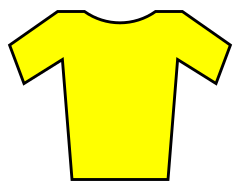 yellow jersey (maillot jaune) |  green jersey (maillot vert) | 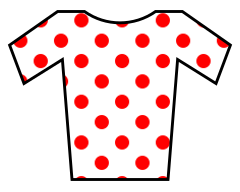 red polka dot jersey (maillot à pois rouges) | white jersey (maillot blanc) |
| Vuelta a Espana |  red jersey (maillot rojo) | green jersey (maillot verde) |  blue polka dot jersey (maillot de lunares) | white jersey (maillot blanco) |
The KoM jersey is awarded to the leader in the Mountain Points competition where points are accumulated over the duration of the Grand Tour event. Points are awarded to the riders who are first over the top of significant climbs, often referred to as categorised climbs.
Other climbing prizes may be awarded at specific Grand Tour events including the Souvenir Jacques Goddet which is a cash prize claimed by the first rider to reach the summit of the Col du Tourmalet when it features in the Tour de France (on one occassion in 2002 it was awarded to the first rider to reach the summit of the Col d’Aubisque). The prize is named in honour of the second Tour de France director.

Categorised Climbs
When a Grand Tour schedule is announced, the associated stage details are published including identification of all associated categorised climbs. The event organisers categorise the climbs from 1 (most difficult) to 4 (least difficult) based on their perceived difficulty including criteria such as gradient and duration. In the Tour de France, a fifth category is reserved for the most severe climbs called Hors Categorie (HC), literally meaning ‘outside category’.
Each of the categorised climbs is assigned points – generally, the more difficults being awarded the most points. Some category 4 climbs may reward the first rider to the summit with just a single point. HC and category 1 climbs may reward mulitple riders with a tapered sequence of points with the first taking the lions share. It is important to note that points are awarded to the first riders to the summit, not necessarily the fastest riders up the climb and positions may be determined by previous events on the stage as well as the climb itself.
As the Grand Tour event progresses, the points are totalled and the leading rider at the end of each stage is awarded the prestigeous KoM jersey to be worn on the following stage. The overall KoM competition winner is the holder of the jersey at the end of the final stage.
“I have always struggled to achieve excellence. One thing that cycling has taught me is that if you can achieve something without a struggle it’s not going to be satisfying.”
Greg LeMond, three-time Tour de France winner
 Grand Tour Climbs